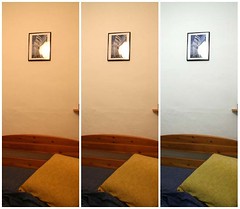
One of the advantages of shooting RAWs over JPEGS is the ability to change the white balance of your image after you've shot it. Most RAW processing software gives you the option of altering the white balance using similar pre-sets to those offered by your camera , using a slider to set a colour temperature or even taking a reading from a neutral area of the image. This versality allows you to get much more accurate white balance than most in-camera systems , especially if you have limited time to take the shot.
Photography Tips
Discusses photography in a simple and quick way : articles , tutorial and tidbits.
Monday, June 7, 2010
Types of Photo Insurance
Lets get to know types of insurance . Select one that suit your need.
Photography Tips
- Household: cover our gear at home but not out of it and usually to aset single item limit. Check your level of cover if in doubt , but adding single items can be more expensive than a dedicated policy particularly if you make a claim , as the following year's premiums may rise
- Trave: slightly better cover offered but still usually limited to a set value per single item claim. Check for cover unattended in a vehicle overnight , for example, and single item claim limits. Ok for smaller cameras maybe , but not for valuable DSLR systems
- Dedicated : cover can be tailored to suit the level of kit and work you do with it. Often seems the pricier option but can include vital third-party liability and indemnity cover. It will cover accidental damage, theft out of the box and usually travel abroad as well. Worlwide cover can be an additional extra. All photographers must consider this as a must-have item if the take any form payment for photography.
Photography Tips
Labels:
insurance
Sunday, June 6, 2010
Chiaroscuro and Contrast
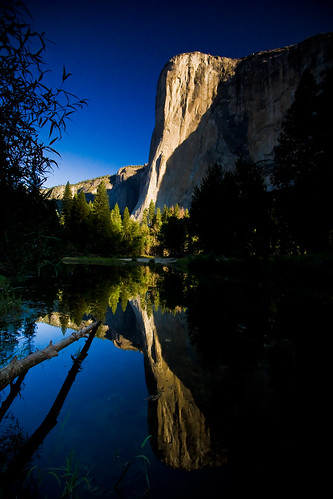
As photography developed as an art form in the early 20th century, many of the luminary photographers like Ansel Adams studied the paintings of the Old Masters. Among the important technique the developed was using light and dark , chiaroscuro , to create drama and scale in a photo. In this image , the dark , semi-silhoutted trees in the foreground frame and define the ethereal grandeur of the mountain in the background.
Photography Tips
Photography Tips
Labels:
chiaroscuro,
technique
More about DOF and point of focus
These are two key elemets , as important as composition . Knowing what to focus on and the how to make it look good. First , we need to understand how DOF ( depth of field ) works. There are two measurements in a landscape you need to consider , from your camera to the point of infinity.
What landscapers attempt is to get this whole frame to look sharp and clear. A small aperture will achieve this , but you dont actually need to always go to the lenses maximum aperture as this may start to show flaws in optical quality.
Thursday, May 27, 2010
What the heck is Aperture ??
mengenal aperture
In photography, the lens aperture functions like the iris of the human eye. Opening and closing to adapt changing light levels. The aperture opens wide to admit more light in low-light situations and closes down to a pinhole when the light gets bright.
With oder cameras , the photographer often had to adjust the aperture setting manually for each shot. However , modern , auto-exposure , digital cameras typically set the aperture automatically to produce the correct exposure as indicated by the cameras built in light meter. But just because we dont have to actively manipulate aperture values doesnt mean that we should ignore the aperture component of your exposures completely.
Friday, March 19, 2010
Framing and Composition
One thing some people don't think about when taking a photo is the look of the final image. Purposely framing and composing elements of the picture in the viewfinder before snapping the shot will usually result in a much better final image.Try thinking of composing the picture as seeing all the visible elements in the viewfinder as parts, and then putting them together as a pleasing whole. Consider what the viewer(s) want to see, then determine the best way to display the main subject.
Also, decide if you should hold the camera vertically or horizontally before snapping the shutter. If you are taking a photo of a single person right in front of you, it is best to hold the camera in the vertical position. If not, you will likely have too much wasted space on each side of the image. On the other hand if you are taking a group or landscape, it is usually better to hold the camera in the horizontal position. You will fill more of the frame with the main subject(s).
Labels:
basic,
camera,
composition
Tuesday, March 16, 2010
Top 10 Black & White Films for Camera
- AGFAPAN APX 25
APX (25) is very fine-grained and very sharp, as befits a slow film. It also offers wide exposure latitude, unusual in a slow film, along with excellent highlight separation. - KODAK TECHNICAL PAN FILM 2415
Texh Pan (ISO 25) is the sharpest, finest-grained pictorial film readily available in 35 cassetes. Develop it in Kodak D-19 developer, and you get very high-contrast negatives.
Friday, March 5, 2010
3 Underwater housing for compact camera
Going diving ? here are some underwater housing , combine with a compact camera.
Canon IXUS 860 IS with WP-DC17 Housing
- Depth rating: 40m
- All functions useable except touch control dial.
- Housing includes: neck strap, wrist strap, diffusion plate, silicone grease, user guide
- Standard ¼" tripod socket at base. Dimensions /mm: 133w, 90h, 67d
- Weight: approx 310g
Labels:
diving,
housing,
underwater
Thursday, March 4, 2010
Portrait Profesional software review
Just found interesting software on the net. I love portrait photography and here is a piece of software can enhance my hobby. It is increadibly easy. It offers complete creative control , allowing me to improve any aspect of the picture instantly , just by moving sliders. Dont take my words , just check their gallery here.
Safe handheld shutter speeds
Photographers usually talk about safe and unsafe shutter speeds - those where camera shake is unlikel and those where its likely. The safe shutter speed is the reciprocal of the lens equivalent focal lenght. For example: when shooting at an equiv of 30mm , we should consisder using 1/30 sec as the minimum safe shutter speed. Simple but it's also misleading. Camera shake doesnt just switch on or off at specific shutter speeds. It is always there , but at higher shutter speeds the camera movement doesnt have time to blur the photo significantly. The other factor is luck :). So safe shutter speeds are an estimate , not an exact hard number
Labels:
imagestabilisation,
shutter,
speed,
tip
Subscribe to:
Posts (Atom)